How to Teach Your Child French at Home (Even If You Don't Speak It)
Have you ever watched your ten-year-old flawlessly memorize a complex, 30-word magical incantation from a cartoon after hearing it exactly once... but the second you sit them down with a digital flashcard to learn the French word for "apple," they suddenly lose all cognitive function?
You have learnt French as a second language in school and now it is your kid's turn to do the same. You are helping as much as you can but you are not a fluent speaker and you resort to the usual drill, flashcards, grammar rules, French shows and TV. But nothing seems to be enough to bring your kid to fluency.
It is incredibly frustrating. You want your child to learn a second language, the school curriculum has it and teacher teaches it 2-4 hours in a week, but the moment the process of "teaching" come into play so does the resistance from the kids.
Why does this happen? Because when we decide to teach our kids French at home or at school, we instinctively revert to the exact system that failed us. We try to replicate the high school classroom. We buy rigid workbooks, we drill grammar rules, and we treat language like a math problem to be solved rather than a song to be sung. And if you are like most parents, the fact that you don't actually speak French yourself makes the whole process feel like a high-stakes, stressful chore.
But what if your lack of fluency isn't a weakness? What if it is actually your biggest hidden advantage?
You do not need a teaching degree or a flawless Parisian accent to give your child the gift of a second language. Here is exactly how to raise a French speaker from the comfort of your own living room, without ever touching a grammar chart.
Why French? The Case for Starting With French
If you are going to invest the time to build a bilingual home, you want a language that offers a massive return on investment. French is an absolute powerhouse on the global stage.
It is the fifth most spoken language globally, an official language in 29 different countries, and the working language of the UN, the EU, and the International Olympic Committee. It opens doors across Europe, North America (Canada), and rapidly growing economies in Africa.
Beyond its geopolitical weight, French is consistently the number one choice for European language learning because it acts as the perfect linguistic bridge. Because English shares a massive amount of vocabulary with French (nearly 30% of English words have French origins), children can quickly identify cognates—a word or language that shares the same historical origin or linguistic root as another. For example, the English word "mother", the German "Mutter", and the Latin "mater" are cognates because they stem from the same ancestral root. Once a child maps the grammatical structure and vocabulary roots of French, acquiring Spanish, Italian, or Portuguese later in life becomes exponentially easier.
You aren't just teaching them how to say "hello." You are handing them a master key to global opportunity.
The Non-Native Parent Advantage
As the kids grow, parents often fall into the trap of acting like a strict teacher. They inadvertently correct their child's grammar mid-sentence, demand perfect pronunciation on the first try, and accidentally drain the joy right out of the room. The child feels tested, and the resistance builds.
When you don't speak the language, the entire dynamic shifts. You are no longer the professor; you are the co-pilot.
You get to learn alongside your child. Just asking the kid small questions. You don't even need to go into details. Your questions become their questions. When you stumble over a word and laugh at your own terrible pronunciation, it completely removes the intimidation barrier. It signals to your child that making mistakes is a normal, fun, and safe part of the game. Your job isn't to be a flawless French tutor. Your job is simply to be the ultimate curator of their French environment, learning right beside them.
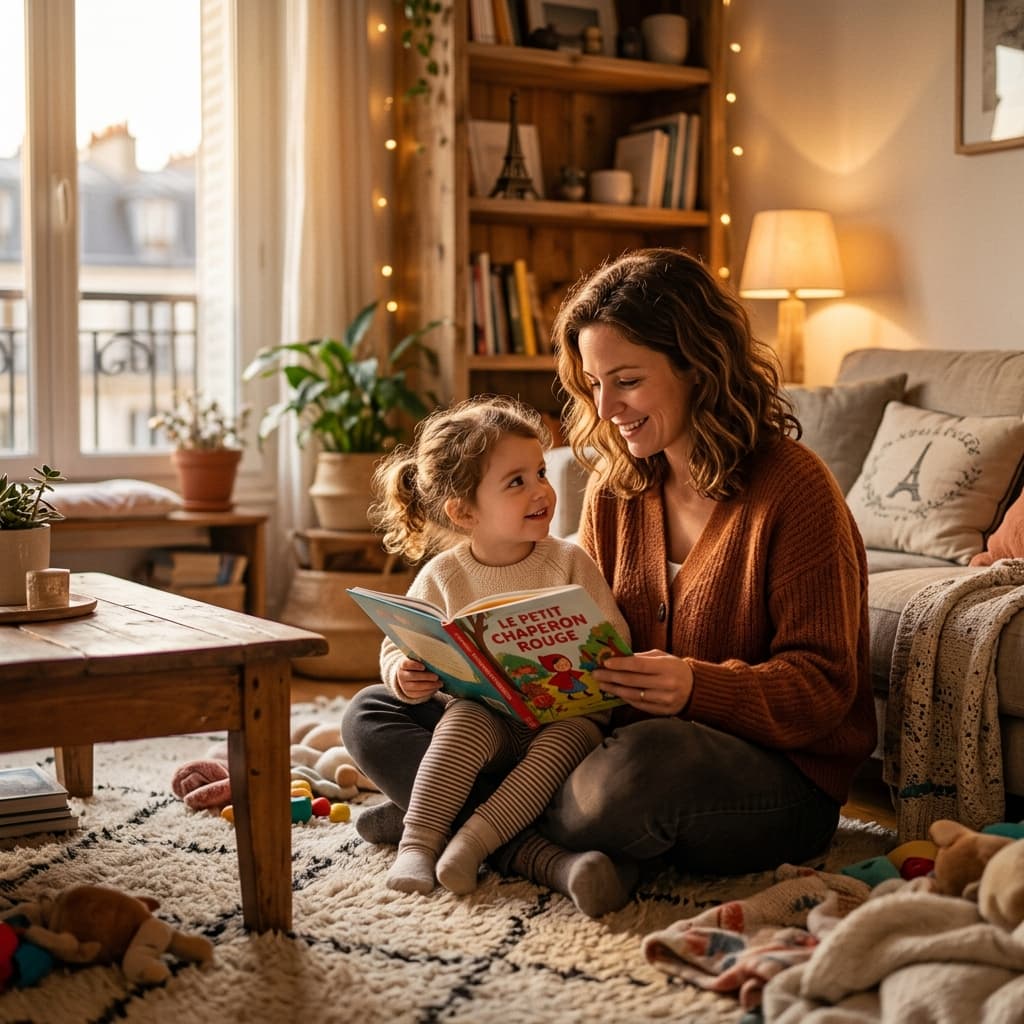
Image: A parent and toddler sitting on a living room rug, both laughing while looking at a colorful French picture book.
How French Phonics Works for Children
To curate that environment effectively, you need to understand what makes French sound... well, French.
For an English-speaking child, French introduces a few entirely new auditory gymnastics. They have to map nasal vowels (like the on in bonjour), liaisons (where the silent last letter of a word suddenly connects to the vowel of the next word to create a flowing sound), and a terrifying number of silent letters at the ends of words.
If you try to explain these phonetic rules to a five-year-old on paper, they will quit immediately. But if you simply expose their brain to early, consistent audio input, they will absorb these complex phonics naturally. A young child's brain is highly plastic and designed for pattern recognition. They will mimic the nasal sounds and sweeping liaisons flawlessly without ever needing to know what those linguistic terms actually mean.
Basic French for Kids: How to Build Their First Vocabulary Without a Single Flashcard
Here's the secret nobody tells you about teaching your child French at home: you don't need a lesson plan. You need a kitchen, a bathtub, and a staircase.
Forget verb conjugations. Forget vocabulary quizzes. At ages 3 to 6, the French words that stick are not the "most useful" ones — they are the ones attached to your child's own little universe. Their breakfast. Their dog. Their own nose. When a French word lands on something your child can see, touch, or point at, magic happens: it stops being a foreign sound and becomes a name for something they love. That's not memorizing. That's acquiring.
So skip the study sessions. Instead, tuck French into the pockets of your day:
Start where the morning starts. Greetings are the perfect gateway into basic French for kids because they repeat every single day, wrapped in warmth and routine. A cheerful French hello over cereal costs you ten seconds — and give it two weeks, and your little one will be saying it before you do.
Turn your kitchen into a classroom (that serves snacks). Mealtimes are pure gold. The same foods show up day after day, which means the same words get reinforced day after day — always in context, never on a flashcard. Offer a choice between two items in French and watch vocabulary become a game your child actually wants to play.
Their body is the best textbook they'll ever own. Bath time, getting dressed, tickle attacks — your child is already laser-focused on hands, feet, and noses. Naming body parts in French during these moments anchors words physically, which is exactly how toddler brains love to learn.
Count everything. Yes, everything. Stairs, blocks, grapes, toes. Numbers slide into daily life more easily than any other French words for toddlers, and kids adore the sing-song rhythm of counting out loud.
And please — stop worrying about your accent. Your job was never to sound Parisian. Your job is to make French feel present, playful, and safe. You bring the pointing, the giggling, and the enthusiasm. Then press play on a Cocoloops story and let a native speaker deliver the perfect pronunciation. You each do what you do best — and your child gets the best of both.
Because here's the truth: teaching your child French at home isn't about hitting a word count. It's about familiarity. A child who hears French sprinkled through their snacks, their bath, and their bedtime story isn't studying a language.
They're falling in love with one. And that's exactly where fluency begins.
So You've Set the Stage. Now, Who Does the Talking?
Everything above makes French familiar. But familiarity alone won't make your child fluent — for that, their brain needs something you can't fake: real French, spoken by real native speakers, with all its rhythm, melody, and music intact.
And this is where most parents panic. "But I can't provide that!"
Exactly. You don't have to. Your role is to build the world; someone else gets to supply the voice. The good news? That voice is easier to invite into your home than you think. Here are the three most effective ways to flood your child's ears with authentic French — no fluency required from you.
Method 1: French Audiobooks and Stories
When you cannot provide native-speaker input yourself, you must outsource it to premium audio.
This is the fastest, most effective way to accelerate phonological acquisition or in other words learn how to speak. By pressing play on a French audiobook, you are flooding your child's brain with perfect pronunciation, native rhythm, and rich narrative context. The brain learns best when it is engaged in a narrative rather than staring at isolated flashcards.
This is precisely the gap Cocoloops was designed to fill. By allowing your child to listen to beautifully produced, character-driven adventures in French, you remove screens from the equation and force their auditory processing centers to step up. They get lost in the story, their imagination takes over, and the French vocabulary seamlessly anchors itself to their long-term memory.
Method 2: French Songs and Nursery Rhymes
Music is the ultimate mnemonic shortcut. The melody acts as a sticky framework for foreign vocabulary, allowing children to memorize entire paragraphs of a foreign language before they can even speak it conversationally.
Swap out your usual background playlist for a few of these classic French children's songs:
- Frère Jacques — The ultimate classic. It is slow, repetitive, and perfect for teaching basic rhythm and the concept of sleeping/waking up.
- Promenons-nous dans les bois — A highly interactive "wolf" game song that systematically teaches clothing vocabulary as the wolf gets dressed.
- Tête, épaules, genoux et pieds — The French version of Head, Shoulders, Knees, and Toes. Brilliant for physical vocabulary anchoring because the child points to the body parts while singing.
- Alouette — A fast-paced, escalating song that is excellent for learning detailed body parts (beak, eyes, head, wings).
- Les petites marionnettes — A gentle, rhythmic song perfect for calming toddlers down while introducing basic action verbs.
Read Next: Screen-free ways to expose your child to a second language
Method 3: French Cartoons (Timed Screen Use)
While we firmly believe screen-free audio is the best primary learning tool, high-quality visual input can be a great supplement if managed correctly. If your child is going to have 20 minutes of screen time while you cook dinner anyway, make that time work for your language goals.
Change the audio settings on Netflix or Disney+ to French. Visual context helps children decode what the characters are saying. Great starter shows include:
- Peppa Pig en Français — The vocabulary is incredibly simple, the narration explicitly describes what is happening on screen, and it is highly repetitive.
- Tchoupi — A beloved, classic French cartoon about everyday toddler life (going to school, playing at the park). It perfectly mirrors a child's daily routine.
- Miraculous: Tales of Ladybug & Cat Noir — For older kids (age 6+) craving action, this show is originally French and highly engaging.
Image: A TV screen showing the audio language menu on a streaming service, highlighting "Français" being selected.
A Simple 4-Week French Starter Plan
Do not try to implement everything on day one. If you overwhelm your child, they will push back. Use this simple, escalating four-week blueprint to build a sustainable family habit:
Week 1: The Audio Anchor
Focus: Greetings and baseline exposure.
Action: Say Bonjour every single morning instead of good morning. Play a simple, 15-minute French Cocoloops story in the car on the way to school or right before bed. There is absolutely no pressure to translate or quiz them on what they heard. Just let the sounds wash over them.
Week 2: The Musical Integration
Focus: Animals and Rhythm.
Action: Keep the daily audiobook habit going. Add 10 minutes of French nursery rhymes to their bath time routine. Start asking simple, mixed-language questions like, "What does le chien say?" to playfully integrate the vocabulary.
Week 3: The Tactile Connection
Focus: Food and Routine.
Action: Label three high-traffic items in your kitchen (Water, Milk, Apple) with physical sticky notes. At dinner, point to the items and ask them if they want l'eau or le lait. The physical act of handing them the item when they use the French word reinforces the meaning instantly.
Week 4: The Story Recap
Focus: Numbers and Comprehension.
Action: Count stairs, toys, or blocks from un to dix together. While listening to their daily Cocoloops story, pause the audio halfway through. Ask them (in English) what they think will happen next, encouraging them to use just one French word they know in their prediction.
Frequently Asked Questions
Which French accent should my child learn?
For young beginners, it absolutely does not matter. Whether they are exposed to Parisian French, Canadian (Québécois) French, or West African French, the foundational vocabulary and grammar rules are identical. Focus purely on consistent exposure first; regional nuance and accent refinement come much later.
How fast will they progress in learning French?
Language acquisition is a slow burn. You may observe a "silent period" for the first few months where they just listen and refuse to speak. This is normal. Suddenly, around month four or five, they will start casually dropping French words into English sentences. Consistency always beats speed.
Should I try to learn French alongside my child?
Yes! Even if you only learn five new words a week. Showing your child that you are willing to struggle, sound silly, and persistently try a new skill is the ultimate motivator. It turns language learning into a team sport rather than a solitary homework assignment.
The Bottom Line
You do not need a teaching degree, a flawless Parisian accent, or a stack of expensive grammar textbooks to give your child the gift of a second language.
By changing the soundtrack of your daily life, swapping out the car radio for a great French audio story, or changing your usual bath time music for a French lullaby, you can build an immersive, multilingual world right inside your own home.
Ready to bypass the frustration of the classroom and start the adventure together?
Put on a French Cocoloops story tonight and let the language flow. Browse the French audiobook collection →
Cocoloops offers native-speaker French audiobooks for children aged 3–15. No app download required to get started.
Tags
Related Posts
All posts
Newsletter
Get new stories & tips in your inbox
Parenting tips, audiobook picks, language learning — weekly.