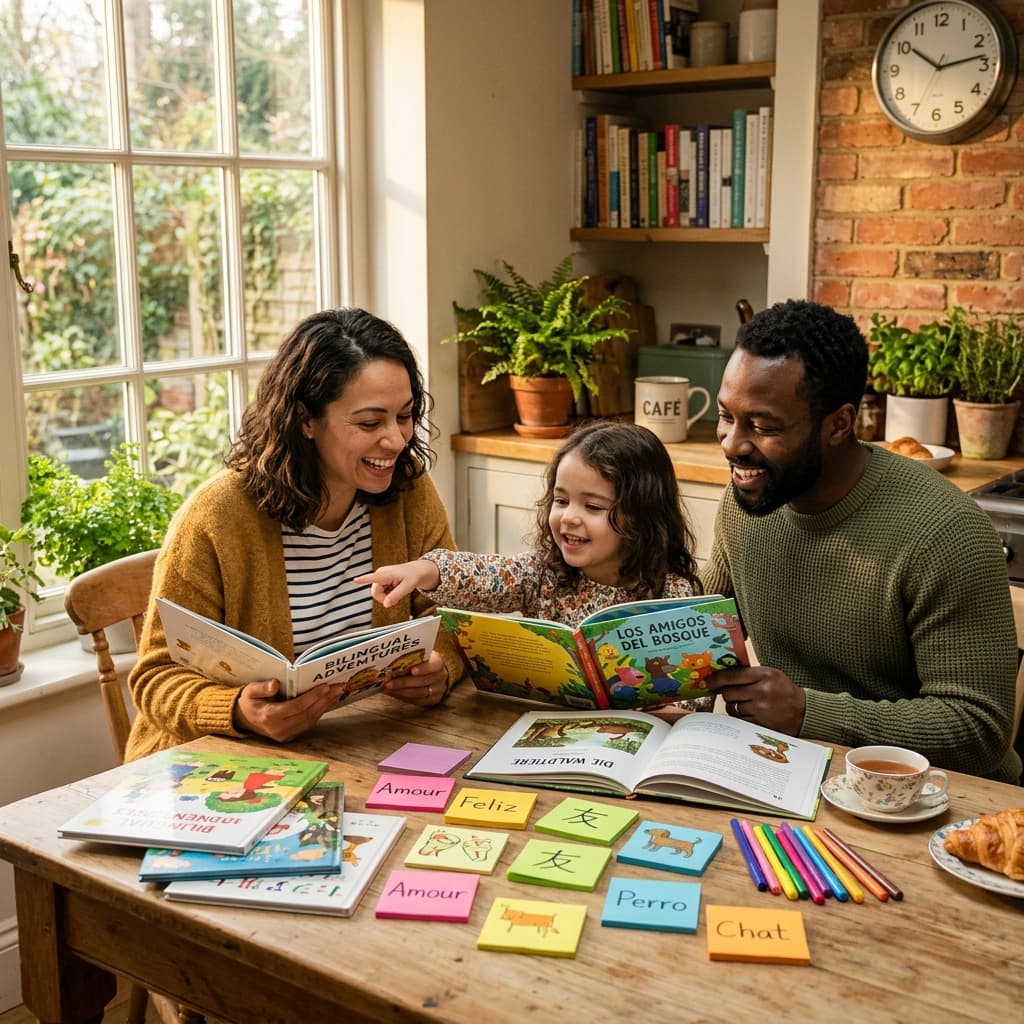
How to Raise a Multilingual Kid When You Only Speak One Language
Every parent wants to give their child an edge — and few gifts are more powerful than a second language. The cognitive benefits, the career doors it opens, the cultures it unlocks. You feel it in your bones. The school teaches a second or even a third language. And yet, the moment you actually sit down to support your kid in learning, a very particular kind of panic sets in. You're looking at your toddler, full of ambition, and suddenly thinking: 'I barely scraped by in high school Spanish, and my French pronunciation is a crime against the entire nation of France. How on earth can I teach my child something of which I am not an expert?'
It feels like an impossible task. You might assume that giving your kid the gift of a second language is a luxury reserved for multicultural households, expats, or linguistic experts.
But here is the most important truth you will read today: You do not have to speak a language to teach it to your kid.
If we look at successful Japanese immersion schools in the United States, or multilingual Waldorf programs scattered across Europe, we see a fascinating pattern. The kids in these programs don't become fluent because their parents are drilling them with vocabulary flashcards at the dinner table every night. They become fluent because they are placed in a rich, immersive environment where the language lives and breathes.
You don't need a linguist, a private tutor, or a native speaker to raise a multilingual kid. You just need a practical playbook to create the right environment at home.
Here is exactly how monolingual parents are successfully raising bilingual kids and how you can do it, too.
Why Non-Native Input Still Works (The Science of Language)
It is easy to assume that kids learn to speak entirely by directly mimicking their parents. While parental interaction is undeniably crucial for emotional bonding and first-language development, it isn't the only way the human brain acquires language.
In the world of linguistics, there is a famous and foundational concept known as Krashen's Input Hypothesis. Dr. Stephen Krashen, a leading researcher in bilingual education and linguistics, proposed that humans do not acquire language by memorizing grammar rules, doing repetitive drills, or passing vocabulary quizzes.
Instead, we acquire language through comprehensible input. This means we absorb it naturally when we hear it in a context we can understand.
Think about how your kid learned their very first language. You didn't sit your one-year-old down with a whiteboard to explain the difference between verbs and nouns. You didn't give them a quiz on the past tense. They simply lived in a house where the language was spoken; they observed the context of those words, and their incredibly plastic brains did the rest of the heavy lifting.
The exact same principle applies to a second or third language. Kids absorb language from audio exposure, environmental context, and narrative storytelling. The input doesn't have to come directly from your mouth; it just has to be present and consistent in their environment.
When you are a monolingual parent, your job isn't to be the primary teacher. Your job is to be the curator of that input.
Strategy 1: Create a Language Environment at Home
If you want your kid to learn a new language, you have to formally invite that language into your home. The good news is that this requires very little effort, zero financial strain, and absolutely zero fluency on your part.
Start with low-effort, daily passive immersion. Buy a pack of sticky notes and start labeling household objects in your target language.
- La puerta goes on the bedroom door.
- La manzana goes on the kitchen fruit bowl.
- El espejo goes on the bathroom mirror.
You don't even have to pronounce these words perfectly when you read them. Just having the environmental print scattered around the house normalizes the target language and makes it a tangible part of their daily reality.
Next, change the background soundtrack of your house. Swap out your usual morning playlist for French jazz, German folk songs, or Spanish nursery rhymes. Scatter bilingual picture books on the living room coffee table so they are always within arm's reach.
By doing this, you are creating a sensory-rich environment where the second language feels like a natural, everyday part of the furniture, rather than a stressful academic subject they are forced to study.
Strategy 2: Leverage Audio Stories and Audiobooks
Sticky notes, background music, and picture books are fantastic for setting the stage. But to actually acquire a language — to move from just recognizing sounds to understanding meaning — a kid needs to hear native pronunciation, natural intonation, and proper sentence structure.
If you don't speak the language, where does that authentic input come from?
This is where multilingual audiobooks become your absolute secret weapon.
Audio stories are the ideal tool for monolingual parents raising bilingual kids. They provide massive amounts of high-quality, native-speaker input without requiring any preparation, lesson planning, or fluency from you. When you play a high-quality audio story, you are essentially bringing a native-speaking storyteller right into your living room.
This is exactly why we built Cocoloops.
We designed the Cocoloops platform to act as the "third voice" in your home. Kids can listen to the exact same story in multiple languages. By utilizing a platform dedicated specifically to multilingual audiobooks, you can expose your kid to perfect, authentic pronunciation wrapped inside highly engaging, character-driven narratives.
Because the stories are compelling, kids get lost in the adventure. And while they are busy imagining the characters and the plot, their brains are quietly and naturally absorbing the vocabulary, syntax, and rhythm of the new language.
Strategy 3: Consistency Over Intensity
Most parents start with a burst of enthusiasm — three apps downloaded in one evening, a stack of bilingual books, a firm resolution to speak only Spanish at dinner. Two weeks later, life gets busy, the apps go unused, and the books gather dust. Language acquisition is heavily rooted in behavioral science, and the golden rule is always this: Consistency beats intensity every single time.
Ten to fifteen minutes of daily, low-pressure exposure is infinitely more effective than a two-hour marathon once a week. The easiest way to achieve this daily rhythm is through a psychological trick called habit stacking — attaching the new language habit to a routine you already complete every single day.
- The School Run: Play a Spanish Cocoloops story during the 12-minute car ride to school.
- Quiet Time: Put on a French audiobook while they are coloring, building Legos, or having quiet time in the afternoon.
- The Bedtime Routine: Make an Italian story the final 10 minutes of their bedtime wind-down ritual.
Once the language becomes a predictable, embedded part of their daily habit loop, the resistance vanishes. It stops being "language learning time" and simply becomes "story time."
Strategy 4: Find Community and Human Connection
While audiobooks and home environments do the heavy lifting for daily exposure, language is ultimately a tool for human connection. You don't have to be the one to provide that fluent conversation, but you can be the facilitator who helps them find those connections.
Look for local language playgroups, library reading times, or cultural events in your city. If you are learning German, look for a local German cultural center.
If you live in a more isolated area without diverse local events, leverage online communities. Platforms like italki, virtual language meetups, or online conversation tutors can give your kid the opportunity to hear and use the language "in the wild."
Surrounding them with a community — even occasionally — validates for your kid that this language actually exists outside of their headphones and is used by real, interesting people to communicate real ideas.
Strategy 5: Embrace Imperfection and Protect the Joy
Finally, to successfully raise a bilingual kid as a non-native speaker, you have to let go of your own ego and the need to be perfect.
If you try to learn a few words alongside your kid, your accent is probably going to be terrible at first. You will mispronounce things. You will mix up vocabulary words. That is perfectly okay.
Unlike most adults, kids are incredibly forgiving and they do not judge your accent. What they do is mirror your energy. If you show enthusiasm for the language, they will absorb that enthusiasm. If you laugh at your own mistakes and treat the process lightly, it shows them that it is safe to take risks and make mistakes of their own.
Your encouragement, your willingness to try sounding a little silly, and your overall joy matter one hundred times more to your kid's success than your immaculate fluency.
Your Month-by-Month Starter Plan
Ready to begin but feeling overwhelmed by the logistics? Don't overcomplicate it. Here is a simple, highly effective roadmap for your first year of monolingual-to-bilingual parenting.
Months 1–3: The Sound Bath
Do not worry about your kid speaking yet. Focus entirely on passive exposure and normalizing the new sounds.
- Play target-language music in the kitchen while making dinner.
- Put up those sticky-note labels around the house.
- Let them listen to short audio stories in the background while they play.
Your only goal during this quarter is to make the rhythm and phonetics of the new language feel familiar and safe.
Months 4–6: The Bedtime Ritual
It is time to implement active habit stacking. Introduce a 10-to-15-minute audiobook routine right before sleep.
- Let your kid choose a story they genuinely like on Cocoloops.
- Play it in the target language as they wind down.
The human brain actively consolidates memories and new information just before and during sleep, making this the absolute optimal time of day for language absorption.
Months 7–12: The Breakthroughs
This is when you will start noticing the magic happening. They might suddenly recognize a word, hum a foreign-language song perfectly, or — in a very proud parenting moment — even correct your pronunciation.
Celebrate these micro-milestones loudly! Do not put pressure on them to speak in full, grammatically correct sentences. Just praise their curiosity, answer their questions, and keep the daily audio habit going strong.
Frequently Asked Questions
Can a kid really become fluent if the parents only speak one language?
Yes. Countless kids achieve fluency in a second language through immersion schools, community exposure, and high-quality audio tools, even if their parents are strictly monolingual. The key is providing consistent, daily access to native-speaker input (like audiobooks or tutors) rather than relying on the parents to teach the language directly.
What is the best age to start teaching a kid a second language?
While a kid can learn a language at any age, research shows that the "critical period" for language acquisition peaks before the age of 7. During this window, kids process new languages using the same part of the brain they use for their native tongue, allowing them to acquire authentic accents and intuitive grammar much faster than adults.
Will exposing my toddler to two languages cause speech delays?
No. This is a common and outdated myth. While bilingual kids might occasionally mix vocabulary from both languages in a single sentence (known as code-switching), this is a sign of high cognitive function, not a delay. Bilingualism does not cause language disorders or long-term speech delays.
Do I need to use screen time to teach my kid a language?
Absolutely not. In fact, passive screen time (like watching cartoons) is often less effective for language acquisition than audio-only formats. Audiobooks force the brain to actively engage in visualizing the story, which builds stronger neural connections. Screen-free audio platforms like Cocoloops protect your kid's attention span while delivering rich, immersive language input.
The First Step is the Easiest
Raising a multilingual kid is about acting as an enthusiastic guide and providing your kid with the right tools.
You don't need a rigid academic curriculum, you don't need flashcards, and you certainly don't need to be fluent. You just need a great story, told by a native speaker, played consistently.
And we are confident that your search for a great story in multiple languages ends right here.
Start tonight with a free Cocoloops story → — absolutely no language skills required.
Cocoloops offers multilingual audiobooks for children aged 3–15 in French, Spanish, German, Italian, and Hindi. Available globally.
Tags
Related Posts
All posts
Newsletter
Get new stories & tips in your inbox
Parenting tips, audiobook picks, language learning — weekly.